TYPHON KUVUO Series vs Standard Mini Excavators Comparing Hydraulic Technology and Premium Cab Features
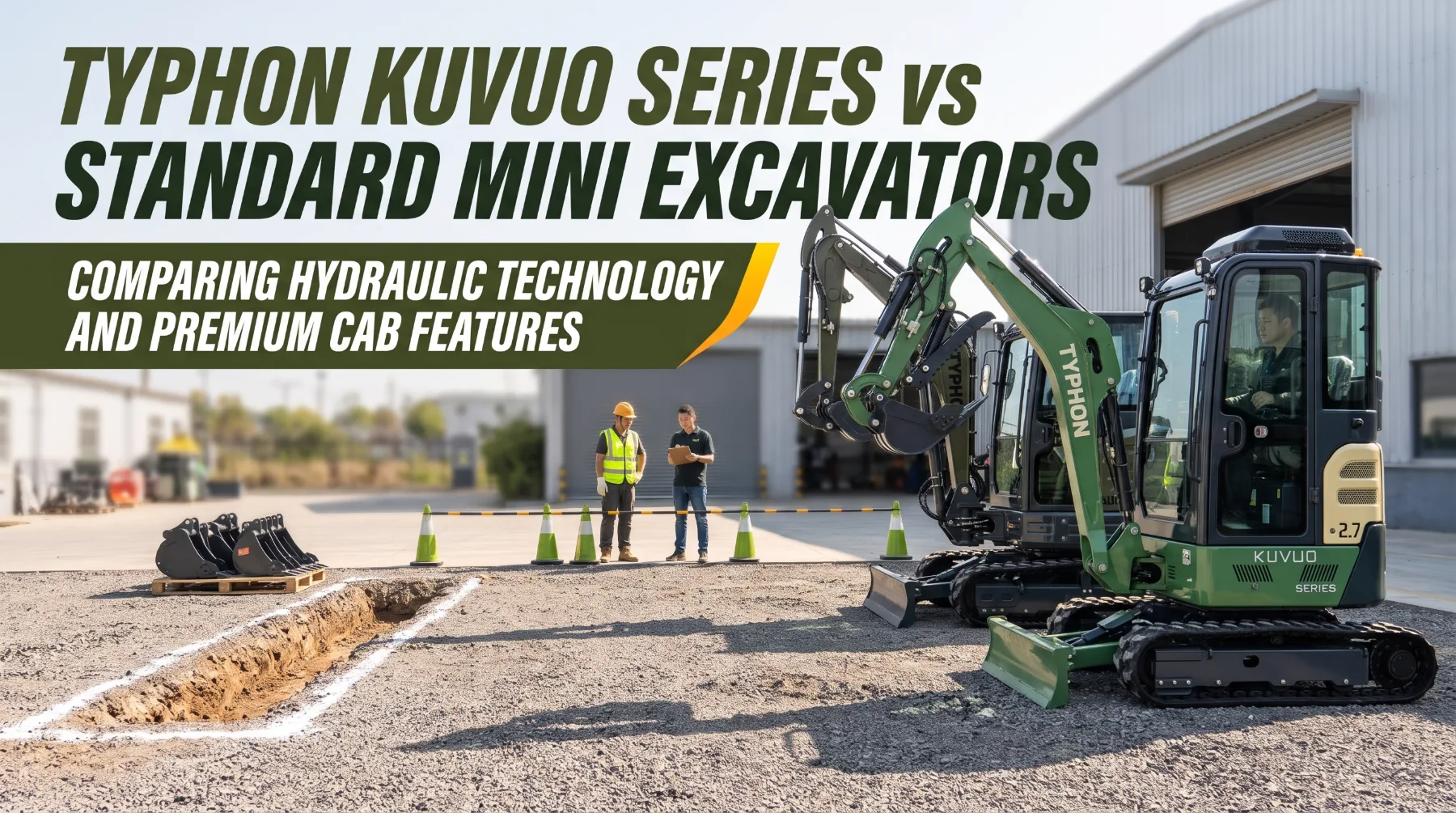
Two mini excavators can look almost identical in a dealer yard. Both have similar operating weights, rubber tracks, and a dozer blade. The differences show up after the first full shift: one machine feathers smoothly along a footing while the other jerks at low speed, and one operator finishes the day alert while the other has spent eight hours fighting heat, dust, and heavy levers.
Those differences come from hydraulic technology, control design, and the operator environment. The TYPHON KUVUO Series is positioned as a high-end compact excavator lineup. The KUVUO 2.7 combines a variable-displacement axial piston pump, full pilot controls, and an enclosed cab with heating and air conditioning. This guide explains how those features compare with standard mini excavator configurations, so you can judge whether premium equipment fits your work and your budget.
Review Hydraulic Flow and Pressure
Flow and pressure explain how a hydraulic system supports digging and attachment work. Flow, measured in gallons per minute, sets how quickly cylinders and motors move. Pressure, measured in PSI, contributes to the force available for breakout, lifting, and driving attachments. Neither figure tells the full story alone.
The KUVUO 2.7's published hydraulic specifications include a total flow of approximately 17.91 GPM at an operating pressure of approximately 2,973 PSI. A common estimate of theoretical hydraulic horsepower multiplies flow by pressure and divides by 1,714, which puts those figures at roughly 31 hydraulic horsepower. Real output is lower because pumps, valves, and hoses lose some energy as heat, but the calculation helps you compare systems on a consistent basis.
When you compare the KUVUO 2.7 with a standard machine, check that published figures were measured under the same conditions. Some manufacturers list total system flow, while others list a single pump section or auxiliary flow only. Peak flow and peak pressure also rarely occur at the same moment, since many systems reduce flow as pressure climbs to stay within engine limits. Ask how each figure was measured and at what engine speed.
Attachments add another layer. If augers, breakers, or thumbs are part of your workload, compare the auxiliary hydraulic flow and pressure with each attachment manufacturer's requirements, including any continuous-duty or case-drain needs. A mismatch reduces performance and shortens component life.
Key takeaway: The KUVUO 2.7 delivers approximately 17.91 GPM at about 2,973 PSI. Compare flow and pressure together, under the same measurement conditions, and check auxiliary specifications for your attachments.
Examine Control Responsiveness
Operators experience a machine's hydraulic engineering through the controls. Control design decides how much effort each movement takes, how predictable the machine feels at low speed, and how easily an operator blends boom, arm, bucket, and swing into one fluid cycle.
Some standard mini excavators use direct mechanical linkage, where levers connect more directly to the control valves. These systems are simple and familiar, but they typically require more hand effort and offer less refined low-speed response. Over hundreds of cycles a day, that effort adds up to fatigue and less consistent bucket work late in the shift.
The KUVUO 2.7 uses full pilot controls. Joystick movements send low-pressure hydraulic signals to the main control valves, which then direct high-pressure flow to the working functions. Because the operator moves only a low-pressure signal, joystick effort stays light. Pilot controls also deliver proportional response, so small inputs produce small, measured movements and larger inputs increase speed. Paired with the variable-displacement pump, that proportional control helps operators trim a trench bottom to grade, feather the bucket along a footing, and expose a marked utility gradually.
During any comparison, have your operators run each machine through combined movements, slow metering, and repeated cycles. Ask which control patterns each model supports and whether the pattern can be changed, since matching your crew's familiar pattern shortens training and reduces the risk of unintended movement.
Key takeaway: Full pilot controls on the KUVUO 2.7 provide light effort and proportional response for precise work. Test control feel, metering, and pattern options with your own operators.
Evaluate Enclosed Cab Features
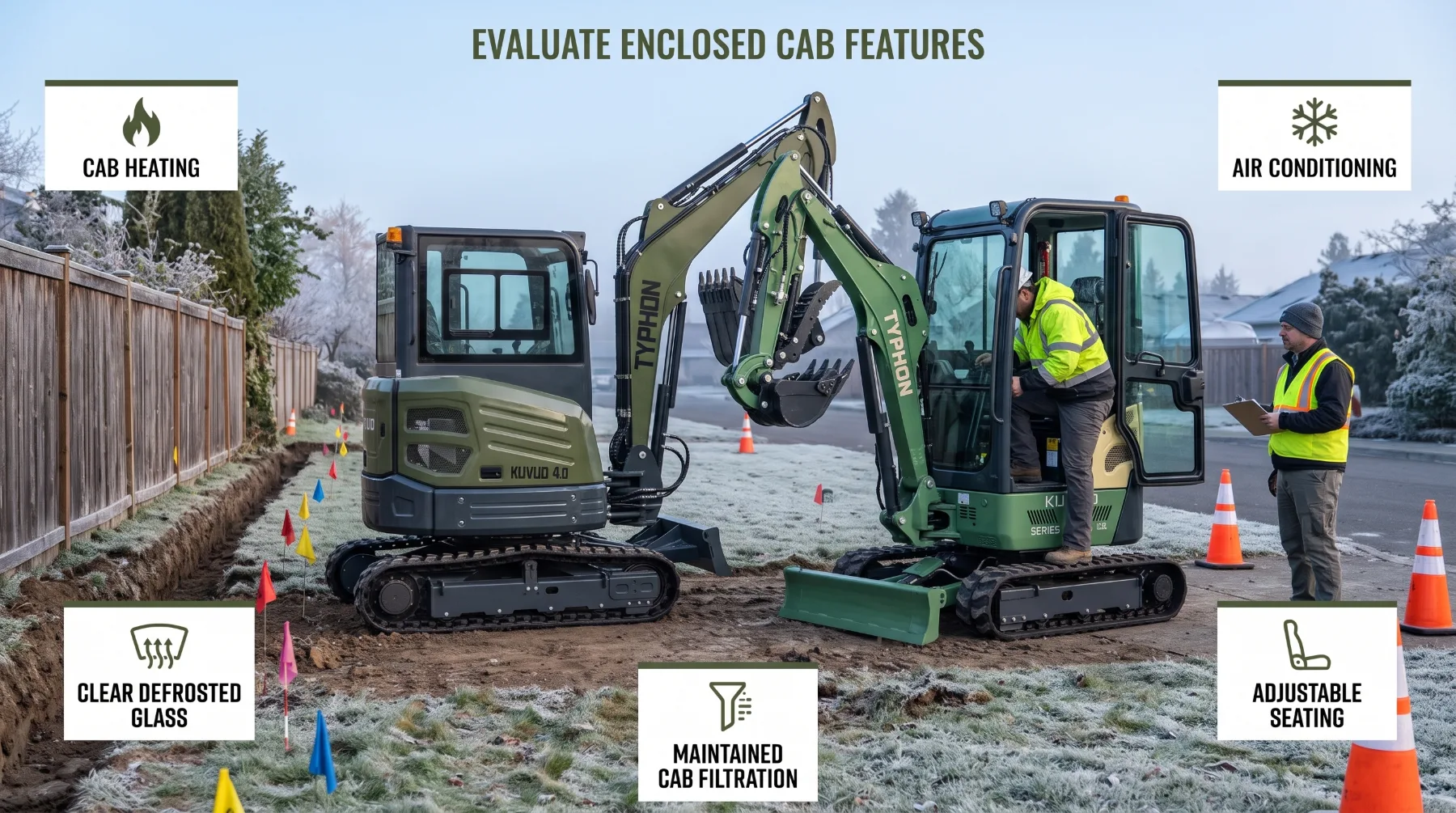
Many standard mini excavators come with an open canopy. A canopy provides overhead protection and works well in mild climates, but it leaves the operator exposed to wind, rain, cold, heat, and dust. On long shifts or in seasonal extremes, that exposure slows reaction time, reduces concentration, and shortens productive days.
The KUVUO 2.7 includes an enclosed cab with heating and air conditioning. The enclosure reduces weather exposure and creates a working space that can stay warmer, cooler, and quieter than the surrounding site. Heating supports early winter starts and defrosting, which keeps glass clear of fog and frost. Air conditioning cools the cab and lowers humidity during summer work. Together, these features help operators stay alert and accurate across the full shift and through more of the year.
An enclosed cab is not complete environmental protection. Sealing, ventilation, and filtration vary by design and depend on regular maintenance. On concrete, rock, and demolition work, dust can contain respirable crystalline silica, so treat the cab as one part of a broader dust control plan that includes water suppression, maintained door seals, clean cab filters, and any respiratory protection your exposure assessment requires.
When comparing cabs, look beyond climate control. Assess visibility to the bucket and tracks, seat adjustment and support, joystick and pedal reach, entry and exit, and the location of the emergency exit. Confirm in writing which cab and climate features are standard or optional on each configuration, including the KUVUO 4.0. Operators must always wear the seat belt, and the cab structure should never be drilled, welded, or modified.
Key takeaway: The KUVUO 2.7's enclosed cab with heating and air conditioning supports comfort, clear glass, and steady output in changing weather. Verify cab equipment, filtration, and ergonomics on each model you evaluate.
Consider Working Performance
Premium hydraulics and a comfortable cab only add value when the machine fits the work. Digging depth, reach, lifting capability, operating weight, and track dimensions decide whether an excavator can complete your typical projects without constant repositioning or extra machines.
The KUVUO 2.7 has a specified digging depth of approximately 6.07 feet and a reach of approximately 9.94 feet. That range covers many residential, landscaping, irrigation, drainage, and utility tasks. Compare those figures with the standard machines you're considering and with the trench depths, footing depths, and spoil placement distances your regular jobs require.
Size and access matter as much as capability. Review overall width, tail swing, transport dimensions, and verified operating weight against your trailer, tow vehicle, and typical access points such as backyard gates and narrow side lots. A machine that can't reach the work area adds little value, whatever its features.
Avoid assuming that premium features automatically mean higher productivity. A well-matched standard machine can outperform a premium model on work that doesn't use its strengths. The right choice depends on how much of your workload involves precision digging, long shifts, harsh weather, and attachment use, which are the conditions where the KUVUO 2.7's hydraulics and cab deliver the clearest returns.
Key takeaway: Compare digging depth, reach, weight, and dimensions against your real projects. Premium features pay off most when your work rewards precision, comfort, and long productive shifts.
Compare Hydraulic Pump Designs
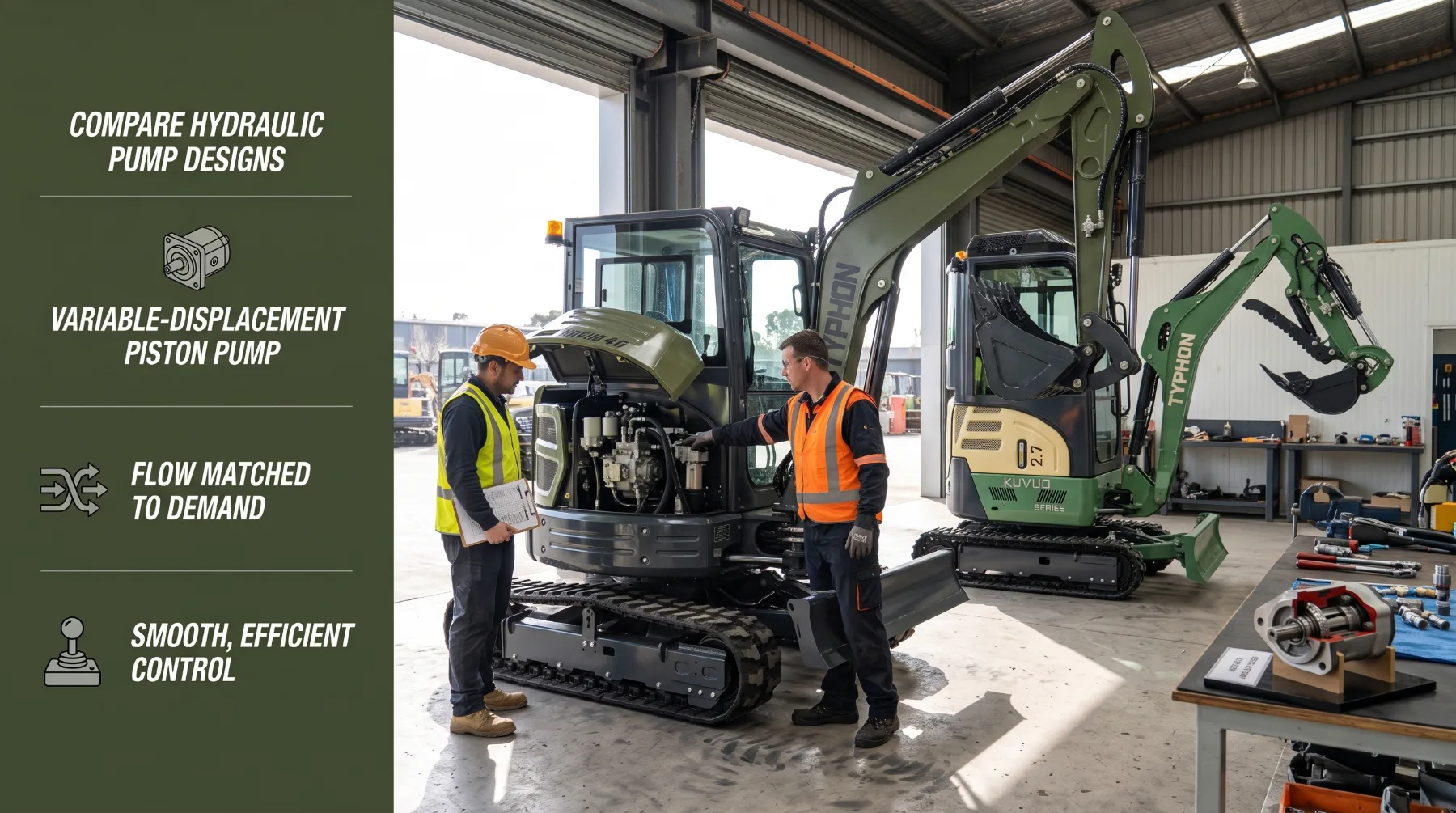
The hydraulic pump turns engine power into the oil flow that moves the boom, arm, bucket, swing, travel, and attachments. Pump design has a direct effect on how smoothly the machine responds, how efficiently it uses fuel, and how much heat the system produces over a long shift.
Many standard mini excavators use fixed-displacement gear pumps. A gear pump delivers the same volume of oil with every revolution, regardless of what the operator is asking the machine to do. That design is simple, durable, and economical to build. The trade-off is that excess flow not needed at the cylinders is often routed back through a relief valve, which wastes energy as heat and can make fine, low-speed movements harder to control.
The KUVUO 2.7 uses a variable-displacement axial piston pump rated at 28 ml per revolution. An axial piston pump uses pistons arranged parallel to the drive shaft, and a variable design changes how much oil it delivers per revolution based on system demand. When the operator needs speed, the pump supplies more flow. When the work calls for precision, it delivers less. That approach supports refined movement near foundations and utilities, steadier performance under load, and more efficient use of engine power.
Pump type varies widely by manufacturer and model, so don't assume every compact excavator uses the same technology. Ask each dealer to state the pump type in writing, along with displacement and control methods. For the KUVUO 4.0, confirm its pump configuration directly rather than assuming it matches the 2.7.
Key takeaway: The KUVUO 2.7's variable-displacement axial piston pump adjusts output to demand, which supports precise control and efficient power use. Confirm pump type on every machine you compare.
Assess Ownership and Service Support
A premium machine should be judged by what it costs to own and keep running, not only by the features it offers on delivery day. Maintenance access, parts availability, warranty terms, and dealer or manufacturer support all shape long-term value and uptime.
Start with serviceability. Check how easily technicians can reach filters, fluid fill points, grease fittings, and the hydraulic pump. Ask for the full maintenance schedule, including hydraulic fluid and filter intervals, and confirm the specified hydraulic fluid. Piston pump systems reward clean fluid and consistent filter changes, so build those intervals into your service plan from the start.
Then look at support. Ask which filters, seals, hoses, and wear parts are stocked, and how quickly non-stock parts arrive. Confirm whether technical support and field service are available, what the warranty covers and for how long, and which maintenance records are required to keep coverage valid. Request these answers in writing.
Finally, keep your own records. Log service dates, hour meter readings, fluid changes, and repairs. A complete history supports warranty claims, reveals recurring issues early, and strengthens resale value when it's time to upgrade.
Key takeaway: Evaluate maintenance access, parts availability, warranty terms, and service support alongside features. Confirm support details in writing before purchase.
Conclusion
The TYPHON KUVUO Series offers contractors a high-end alternative to standard mini excavator configurations, combining advanced hydraulic technology, responsive controls, and operator-focused features. The KUVUO 2.7 is equipped with a variable-displacement axial piston pump rated at 28 ml per revolution, delivering approximately 17.91 GPM at about 2,973 PSI. This hydraulic system works alongside full pilot controls to support precise movements, responsive operation, and efficient power delivery during demanding excavation tasks. An enclosed cab with heating and air conditioning adds another advantage by helping operators maintain a comfortable working environment through long shifts and changing weather conditions. These features make the KUVUO 2.7 worth considering for contractors who need compact equipment with strong hydraulic capabilities and practical operator comfort. However, selecting the right excavator requires evaluating more than individual specifications. Buyers should consider typical digging requirements, working range, site access, attachment compatibility, transport limitations, and long-term maintenance needs. Comparing pump technology, hydraulic flow and pressure, control design, cab equipment, and service support across shortlisted models provides a clearer understanding of overall value. All specifications should be confirmed in writing for the exact model and configuration, since features may vary across the series. A hands-on demonstration on representative ground allows operators to assess hydraulic response, control feel, visibility, comfort, and digging performance. This evaluation helps contractors make a confident investment in equipment that supports daily productivity and long-term business requirements.
Frequently Asked Questions
What hydraulic pump does the KUVUO 2.7 use?
The KUVUO 2.7 uses a variable-displacement axial piston pump rated at 28 ml per revolution, with approximately 17.91 GPM total flow at around 2,973 PSI.
Are all mini excavators equipped with piston pumps?
No. Hydraulic pump types vary by manufacturer and model. Many standard mini excavators use fixed-displacement gear pumps, so confirm the pump type in writing for each machine you compare.
What are the benefits of an enclosed cab?
An enclosed cab reduces exposure to weather and some dust, while heating and air conditioning keep operators comfortable and glass clear. Protection levels depend on sealing, filtration, and maintenance.
What should buyers compare besides hydraulic technology?
Review digging depth, reach, operating weight, dimensions, control design, cab features, service access, parts availability, and warranty support.
kuvuo.net Featured Equipment
Looking for top-performing heavy equipment, authentic attachments, and dependable jobsite power? Explore verified models backed by manufacturer warranty and nationwide delivery.
View Specifications & Pricing →Need help turning this research into a real quote request?
Send the machine category, intended use, or product name to the KUVUO team and we can help you take the next step.
Contact KUVUO